

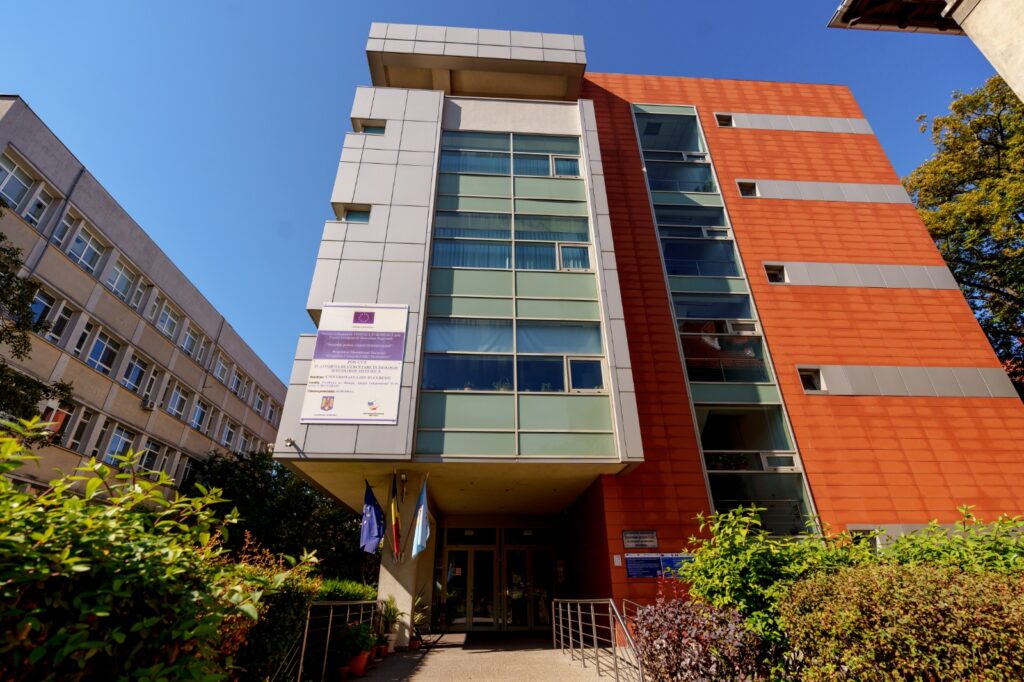
The Platform for Research in Systems Biology and Ecology (PCBE), belonging to the Faculty of Biology, University of Bucharest, brings together a modern multi-storey infrastructure for fundamental and applied research – from molecular biology and genomics to cell culture, advanced imaging, flow cytometry, next-generation sequencing and microbiology. PCBE is envisioned as an integrated ecosystem, supporting the whole experimental pathway: sample preparation → omics analysis → molecular validation → cell validation → cell experiments → imaging and phenotyping → sequencing and microbial analysis.
First floor – Environmental analysis, analytical chemistry and eco-technological processes
The first floor of the Research Platform in Systems Biology and Ecology (PCBE) is dedicated to advanced chemical analysis of environmental samples, development of eco-technological processes and detailed characterization of organic and inorganic compounds in ecosystems. The infrastructure supports interdisciplinary research at the interface between biology, chemistry and environmental science, providing a complete experimental framework – from sample preparation and extraction to molecular identification and assessment of remedial processes.
The platform includes high-performance systems for elemental and isotopic analysis used to study food webs, identify energy sources in ecosystems and investigate biogeochemical cycles. Determination of total, organic or inorganic carbon in liquid and solid samples is performed by dedicated analyzers, essential for monitoring the quality of water, soil and sediment.
For the characterization of contaminants and low molecular weight biomolecules, the floor has a complex liquid and gas chromatography infrastructure, coupled with mass spectrometric detection or specific detectors (fluorescence, conductivity, UV-DAD, RI). These systems allow the identification and quantification of xenobiotic compounds, such as pesticides or pharmaceuticals, as well as the analysis of hydrocarbons, carbohydrates or volatile and semi-volatile organic compounds. In addition, an automated gel permeation system facilitates sample purification and concentration prior to chromatographic analysis.
The structural and functional characterization of biological materials and samples is supported by modern spectroscopic techniques such as FT-IR spectroscopy and UV-VIS spectrophotometry, including monitoring of chemical or enzymatic reactions under controlled conditions. The platform also includes solutions for accelerated solvent extraction, useful in the recovery of organic compounds from complex solid matrices.A distinctive component of the floor is dedicated to the development and testing of water treatment and purification processes, including experimental facilities with catalytic reactors and modular membrane systems, as well as equipment for advanced ozone-based oxidation processes. These allow the simulation of real remediation conditions and the optimization of pollution abatement technologies in aquatic environments.
In the biotechnology and applied microbiology area, the floor is equipped with laboratory bioreactors, incubators, centrifuges and thermal control systems, which support microbial cultivation and small and medium-scale experiments. Oxidative analyses and studies on reactive species are facilitated by a dedicated chemiluminometer, and the investigation of cellular processes is complemented by fluorescence microscopy.
Experimental activities are supported by an extensive ancillary infrastructure (rotaevaporators, ultrapure water systems, analytical balances, vacuum installations, ultrasonic homogenization), as well as field equipment for ecosystem monitoring – from leaf area index and physico-chemical water parameters to plankton, sediment and ichthyofauna studies. The first floor thus directly links laboratory research with in situ observations and measurements, providing an integrated perspective on the functioning of natural systems.
More technical details are available here.
Second floor – Genomics, transcriptomics and platforms for molecular analysis
The second floor houses the molecular biology and omics core, built around a BS2+ (ISO8) clean room of approximately 55 m², partitioned into three dedicated areas (nucleic acid extraction, mix preparation and coupling) to ensure rigorous workflows and contamination control. The space is equipped with high-efficiency laminar flow hoods (H14), providing optimal conditions for working with DNA/RNA and for preparing amplification reactions.
The analytical capability is complemented by equipment for nucleic acid quantification and quality control (UV-VIS spectrophotometry and integrity analysis), as well as a fleet of thermocyclers and Real-Time PCR systems, which allow both routine experiments and sensitive quantitative and multiplex analysis. For the separation and documentation of nucleic acids, the floor includes electrophoresis systems and a UV-VIS image analyzer compatible with a wide range of fluorescent dyes.
In addition, the infrastructure supports cutting-edge research through Single-Cell technology (single-cell isolation/processing, reverse transcription and pre-amplification) and a microarray platform for applications such as gene expression, CGH, microRNA, DNA methylation or ChIP. The genetic analysis and sequencing component is supported by a capillary genetic analyzer for fragment sequencing and a PGM Ion Sequencing System (NGS), including for metagenomic evaluations on the 16S rRNA marker.
More technical details are available here.
Third floor – Cell biology, proteomics and advanced phenotyping
The third floor is dedicated to experimental research in cell biology, imaging and phenotyping, offering working conditions compliant with biosafety standards. The centerpiece is a cell culture area organized as a BS2+ (ISO8) clean room, with two distinct areas: one for cell lines and one for primary cultures. Covering approximately 72 m², the infrastructure includes class II biosafety hoods, CO₂ incubators and ancillary equipment for handling and maintaining biological samples under controlled conditions.
For functional analysis and exploration of cellular mechanisms, the floor features a Nikon A1/A1R laser confocal microscope (point-scan, multi-channel spectral detector) capable of delivering high-resolution imaging and fast acquisition – an essential tool in subcellular localization studies, colocalization, cell dynamics and 3D analysis. For screening and spectral measurements, UV/VIS systems and multimode readers are available, useful in cell biology, biochemistry and molecular interaction assays.
The third floor also supports complete electrophoresis and Western blot workflows (including rapid transfer), plus modern gel and membrane imaging systems (including infrared detection), providing a robust framework for protein validations. For the preparation of biological samples, sonication solutions (direct and indirect) are integrated, and for long-term studies under physiological conditions, an automated inverted microscope enables live-cell imaging in CO₂ incubation. Complementarily, a flow cytometer with multiple lasers and detectors provides multiparametric analyses for immunophenotyping, cell cycle, viability, marker expression and population characterization.
More technical details are available here.
Stage IV – Next-generation NGS sequencing, bioprocessing and microbiology
Stage IV extends the capabilities of PCBE to large-scale genomics, microbiology and bioprocessing, being the meeting point between fundamental research and applications with biomedical and environmental relevance. The sequencing component includes an Illumina MiSeq platform, suitable for targeted amplicons (e.g. 16S/ITS), small bacterial/viral genomes and shallow metagenomics, as well as an Oxford Nanopore MinION system for long reads, real-time sequencing and applications such as metagenomics, plasmids, amplicons or direct RNA sequencing.
For high-volume data-intensive projects and complex omics applications, the floor is equipped with PromethION sequencers, which offer high throughput and flexibility for large-scale genomic, transcriptomic and epigenetic projects. In the bioprocessing area, a 4 L bench-top bioreactor allows for aerobic/anaerobic cultures and fermentations with digital monitoring and control, supporting both process optimizations and experimental studies on microbial physiology or microbial-environment interactions.
The fourth floor also includes a microbiology platform for research activities with non-pathogenic microorganisms, with basic infrastructure for cultivation, preservation and analysis (incubators, ultrapure water, laminar flow hoods, spectrophotometry, centrifugation, microscopy). Cell phenotyping is complemented by a compact, easy-to-use flow cytometer, suitable for research as well as for advanced training and interdisciplinary projects.
More technical details are available here.
An open space for training, excellence and collaboration
Through its infrastructure, PCBE supports:
-
preparation and training of students (bachelor, master, doctorate) in modern laboratory techniques and human methodologies;
-
competitive research projects ranging from molecular mechanisms to microbial ecology and cell biology;
-
collaborations with institutes and universities, as well as applied projects with partners in the fields of health, biotechnology and environment.
PCBE is conceived as a modular and scalable platform, where skills and equipment naturally connect between the different floors, accelerating the transition from idea to result – and from experiment to scientific impact
This post is also available in: Română (Romanian)

